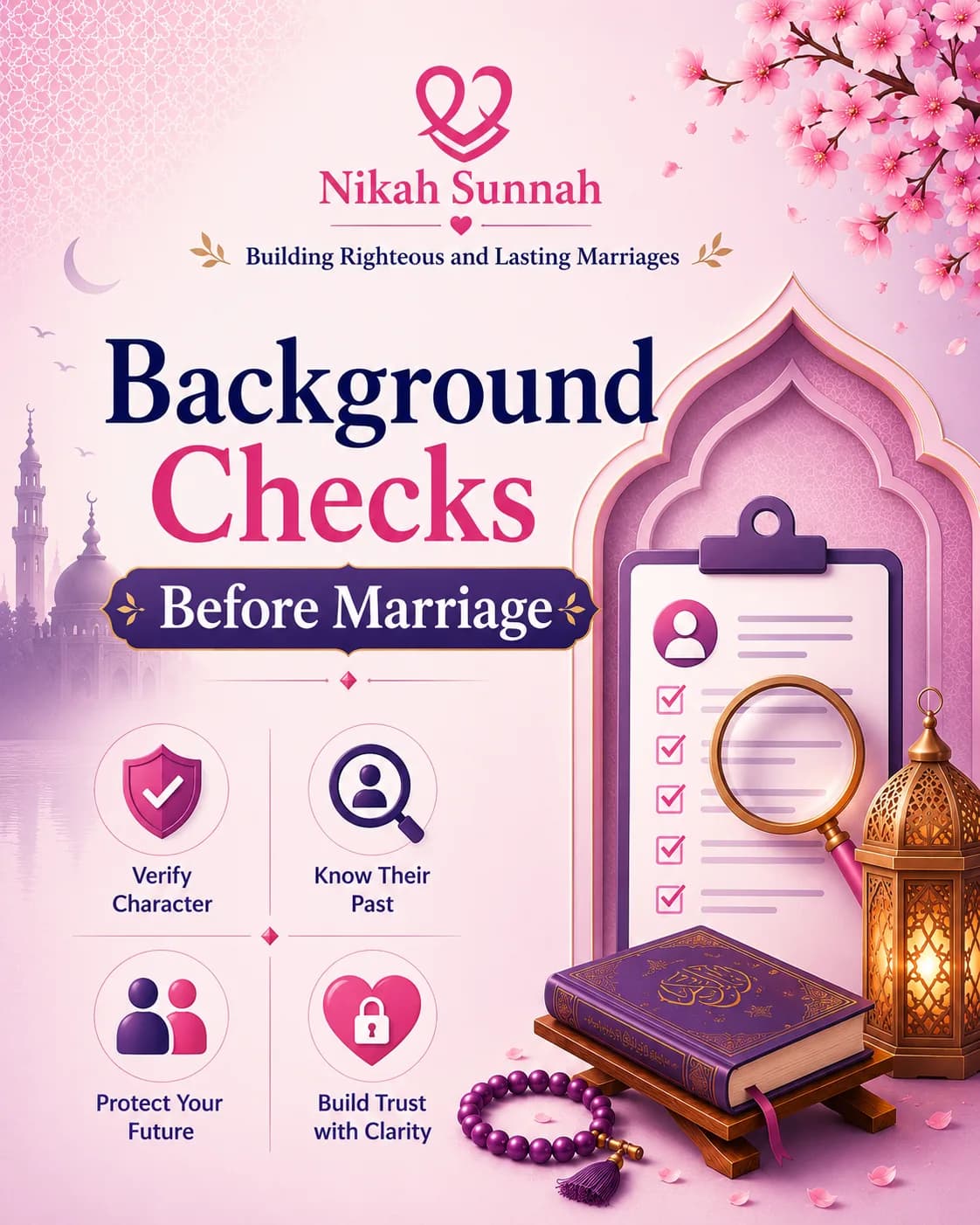
Background Checks Before Marriage in Islam: A Guide to Choosing the Right Spouse
Most marriage arrangements in our community follow the same pattern. A bio-data arrives. It's formatted nicely– height, education, job, a line or two about being "religiously inclined" and "family-oriented."

Saleha Bint Abood Al Amoodi
Contributor
In this article · 10 sections
- 0101. The Living Room Behaviour vs. Reality
- 0202. The Authentic Islamic Foundation for Background Checks
- 0303. The Five Real-World Vetting Arenas
- 041. The local Masjid:
- 052. The neighborhood:
- 063. Observation:
- 074. Workplace (or) University:
- 085. Social Media:
- 0904. Direct Questionnaires and Spiritual Realism
- 1005. Istikhara:
Most marriage arrangements in our community follow the same pattern. A bio-data arrives. It's formatted nicely– height, education, job, a line or two about being "religiously inclined" and "family-oriented." The families meet in a formal living room. Everyone is dressed well, speaking carefully, on their absolute best behavior. Tea is served. The parents discuss mutual acquaintances. A few polite questions are asked.
If the atmosphere feels right and the financial picture looks stable, things start moving toward nikah. What just happened there was not a screening. It was a performance and everyone passed because everyone prepared for it.
01. The Living Room Behaviour vs. Reality#
The Best-Version Illusion: The problem is not that people are deliberately dishonest in these meetings. The problem is that even genuinely honest people present their best version in a formal, high-stakes setting.
What Remains Hidden: Nobody's temper shows up to a rishta meeting.
Nobody's debt, their screen habits, their actual relationship with their deen, or the way they speak to their mother when frustrated, none of that walks into the living room with the tea tray.
You have to look elsewhere to establish true Islamic compatibility in marriage.
02. The Authentic Islamic Foundation for Background Checks#
You have to look elsewhere. And looking elsewhere is not only permitted in Islam, it is what the Prophet ﷺ himself modeled. When Fatima bint Qais came to him asking about two men who had proposed to her, he didn't say give them the benefit of the doubt. He was direct:
The Duty of Full Disclosure:
He named their actual flaws one financial, one about his treatment of women because her entire life was on the line, and being vague would have been a disservice. This is the Islamic foundation for background checks.
Sincerity vs. Backbiting:
When someone is asked about a potential spouse's character, disclosing what you genuinely know is not backbiting. it is an obligation.
The scholars are explicit on this. Concealing known faults when someone's life is about to be affected by them is the actual violation.
Being sincere when someone asks you about a potential spouse is part of that deen. This level of honesty is foundational when researching ‘what to look for in a spouse in islam’
03. The Five Real-World Vetting Arenas#
So where do you actually look when navigating an islamic marriage inquiry?
1. The local Masjid:#
Not whether he talks about Islam on WhatsApp, but whether the Imam or the regular congregants at his neighborhood masjid recognise his face at Fajr.
Send a trusted male relative to speak with whoever has been attending that masjid for years. You will learn more in ten minutes than in three formal family meetings. A man whose faith is genuinely lived leaves a footprint in the house of Allah. If nobody there has ever seen him, the religious language in his bio-data is largely decorative.
2. The neighborhood: #
Neighbors see you when there's nothing to perform, when the car breaks down, when there's an argument audible through the wall, when someone needs help and nobody important is watching.
Send an older relative to speak casually with people on the street or in the building. Ask whether this family is known for being decent, respectful, helpful. Ask if there is noise, disruption, anything that stands out.
People who live nearby often know more about a household's actual character than any relative who only visits on Eid.
3. Observation:#
One more thing and this takes a little more effort but matters. if there's a way for someone to stop by the house without prior notice, even briefly, do it.
How a home looks and functions on an ordinary day, not a prepared one, tells you something real.
4. Workplace (or) University:#
For character outside the home, look at the workplace or university. How does this person treat people who can do nothing for them?
Are they known for being fair and reliable, or do they have a reputation for volatility when things don't go their way? Do they free-mix easily?
Financial discipline and emotional control are not things that appear after marriage they're already present or absent in how someone handles daily pressure. This is a critical metric to evaluate in potential spouse.
5. Social Media:#
Not the curated public profile, but what they actually engage with, who they follow, how they speak in comments/DMs when they think nobody important is watching.
Does what they consume reflect what they wrote in their bio? A person's digital habits are a window into private preferences and those preferences don't disappear after nikah.
04. Direct Questionnaires and Spiritual Realism#
Rehearsed Answers vs. Patterns:
Generic questions get rehearsed answers. If you ask "do you have a temper?" the answer is always no. But ask them to describe the last time something genuinely frustrated them at work or in the family, and then listen to how they talk about the other people involved. If they are flawless in every story, if every conflict in their life has been entirely someone else's fault, that pattern is telling you something.
The Reality Matrix:
Ask about financial pressure specifically not whether they're "good with money" but what their actual plan would be if income stopped for a few months after marriage.
Ask how decisions get made when both people in the home disagree and both are convinced they're right.
Ask about their relationship with their parents not whether it's good, but how they speak about them when things are difficult between them. How a person talks about those closest to them when frustrated is exactly how they will eventually talk about you.
Evaluating History:
And ask carefully about their previous proposals. Whether the rishta broke down or whether it was their decision to move on, how they talk about it reveals something important.
Someone who can say "I wasn't ready at that point" or "there were things on both sides" shows a degree of honesty and self-reflection.
Someone for whom every previous situation was entirely the other family's fault, every breakdown someone else's doing that consistency is worth noticing.
Strategic Toolkit:
Explore our guidebook of “questions to ask before marriage in islam” featuring 40 important questions to ask a potential spouse before marriage.
05. Istikhara: #
Istikhara is important and should be done. But istikhara is what you do after the human work not instead of it.
You don't close your eyes, make du'a, and skip the investigation. You do the investigation honestly and thoroughly, and then you make du'a and trust what Allah shows you.
The difference between those two approaches is the difference between wisdom and wishful thinking.
Final Thought
Finally, if through all of this, you find something genuinely concerning, the most important thing is to be honest with yourself about what you found. Marriage does not repair patterns. It intensifies them. The pressure of shared finances, family expectations, children, and the removal of all the private space someone had when they were single, all of that brings what was already there to the surface faster than anything else.
If someone didn't address a habit or a character flaw for the sake of Allah when there were no stakes involved, your presence in their life will not be what changes it.
Written by
Saleha Bint Abood Al Amoodi
Contributor
Involved in da'wah, study circles, and family counselling, with formal training in Islamic studies and ijazah in hadith. Contributes articles on marriage, personal development, and family life.
Marriage upon the Sunnah.
Without the noise.
Join families and seekers walking the same path. Verified profiles, wali-first, built around the Book and the Sunnah, not endless swiping.
No swiping · Wali-first · Free to register
More from the Sanctuary
Deeper guidance on the path to a Sunnah-rooted marriage.
Practical Guide
Brother-in-Law in Islam: Understanding Islamic Boundaries and Etiquette
"Treat him like your own brother." The "him" being the husband's brother.
Practical Guide
Why Involving Others in Your Marriage Can Do More Harm Than Good
A minor argument happens. Maybe he was short with you before leaving for work. Maybe there was a disagreement about money, or something to do with his family. Nothing serious just the kind of friction that is completely normal when two people are learning to share a life. But within the hour, the phone is out.
Practical Guide
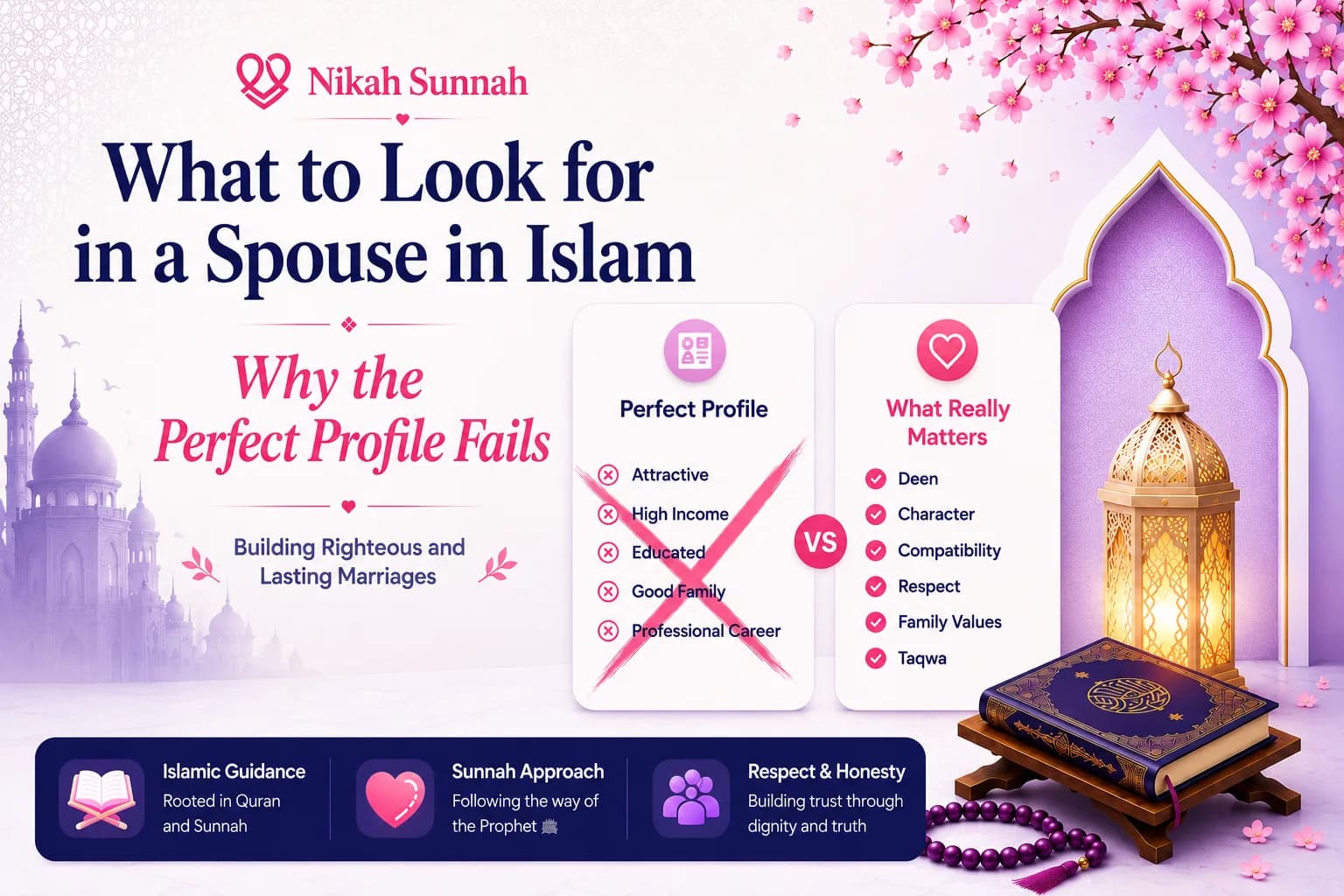
What to Look for in a Spouse in Islam: Why the Perfect Profile Fails
I've heard this story more times than I can count now. The profile comes through he's abroad, well-settled, the right degree, the right height, good family background. Or her profile comes through she's beautiful, writes about her qualifications, the family is well-respected. Calls are exchanged. Guardians are involved. Somewhere in the background you can hear families calculating whether this is finally the one.