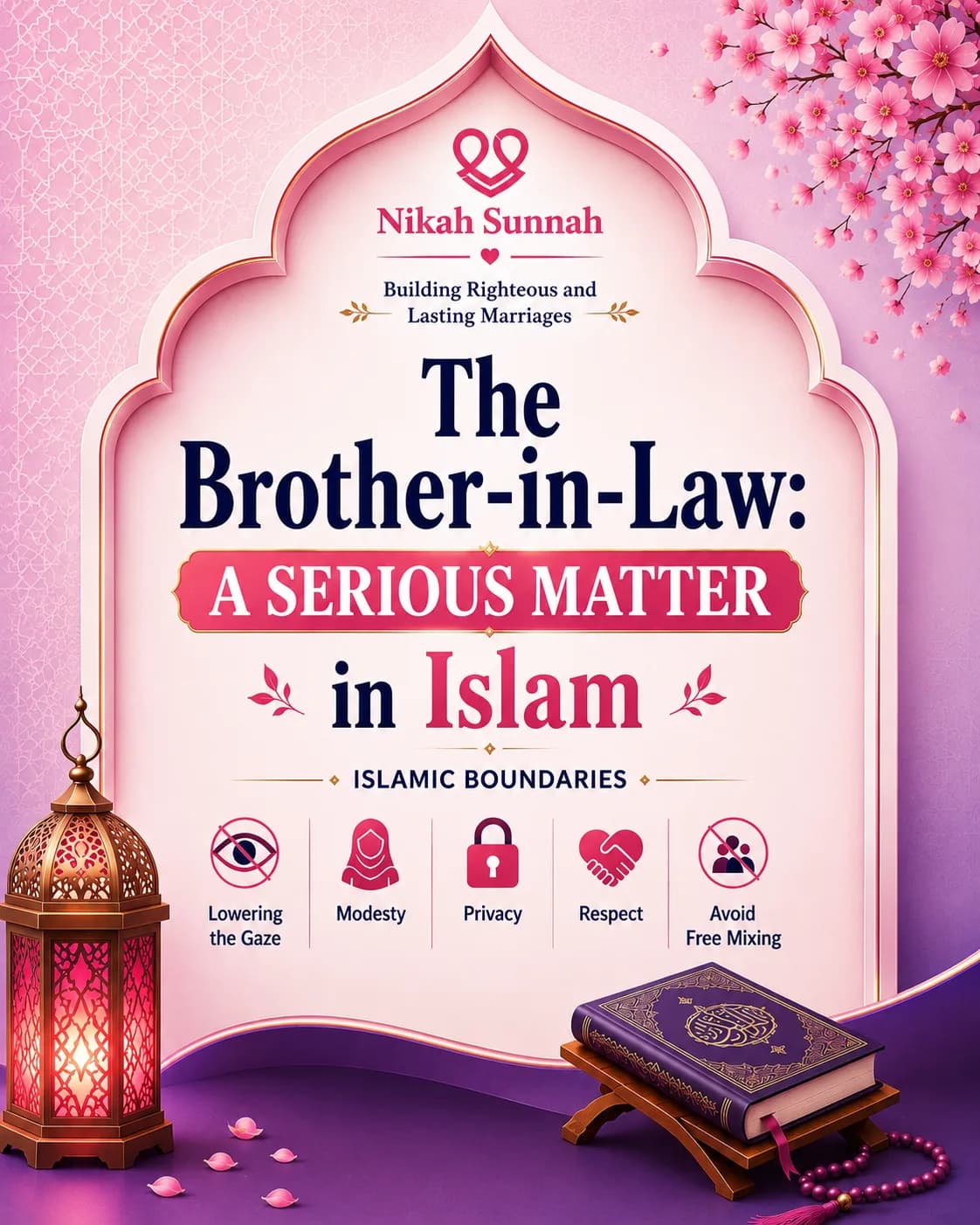
Brother-in-Law in Islam: Understanding Islamic Boundaries and Etiquette
What Islam actually says about your husband's brothers, the cultural myth of the "home brother," and understanding joint family boundaries.

Saleha Bint Abood Al Amoodi
Contributor
In this article · 4 sections
There is a phrase that gets said to almost every new bride in a South Asian home, usually within the first week. It comes warmly from a mother-in-law, from well-meaning aunties, sometimes from the husband himself.
"Treat him like your own brother." The "him" being the husband's brother.
The one who shares the same roof, the same kitchen, the same living room. And so she does. She eats at the same table, sits in the same room, exists without a barrier because she has been told, and has genuinely come to believe, that this is what family respect looks like. This is how a "good bahu" behaves. Nobody told her what the Prophet ﷺ said about this arrangement. This hidden conflict highlights why singles must prioritize studying marriage in islam rules / rights before committing to a home.
01. The South Asian Cultural Illusion#
i] The Proximity Practice:
In traditional setups, a new bride is expected to treat her husband's brother exactly like her biological family.
ii] The Normalization of Intermixing:
She eats at the same table, sits in the same room, and exists completely without a barrier because of cultural narratives.
iii] The Missing Education:
This is often passed off as what family respect looks like, yet it entirely ignores the foundational rules of islamic marriage boundaries.
This blindspot is an essential factor when deciding ‘what to look for in a spouse in islam’
02. Proximity: Why the Prophet ﷺ Warned of This Danger#
When someone asked the Messenger of Allah ﷺ directly about a husband's male relatives the brothers, the cousins, those who share a home he replied with two words that are impossible to water down:
Why the Word "Death" Was Chosen:
He used that word deliberately because unlike a stranger on the street, the brother-in-law has something far more dangerous than bad intentions; he has proximity.
The Danger of Unchecked Access:
He has a key to the front door, knows her daily routine, and sees her relaxed, off-guard, in her home clothes. He interacts without any of the formality she would naturally maintain with an outsider.
Familiarity is the Flag:
The very thing that makes him feel "safe" the familiarity, the shared history, the label of family is precisely what the Prophet ﷺ was flagging as the danger.
Intentions Do Not Change the Rule:
This has nothing to do with whether he is a good person.
The Sahaba were the best generation of human beings to walk this earth, and they still needed these boundaries to guard their homes. If they needed the boundary, the argument that "our intentions are clean so it doesn't apply to us" doesn't hold for anyone seeking a practising muslim.
03. Dwellings and Privacy: A Wife's Islamic Prerogative#
But here is something most conversations about this topic never get to and it's the part that actually changes things for the woman living inside this situation. Islam gave a woman a right.
The Right to Accommodation:
A wife has the Islamic right to her own separate accommodation; a space that belongs to her, where she is not required to share her living quarters with her husband's family.
The Divine Command:
This is not a cultural preference or a nice-to-have. It is her haqq, established directly in the Quran:
"House them where you dwell, according to your means" (At-Talaq, 65:6).
The Scholarly Consensus:
The scholars including Ibn Qudamah in Al-Mughni and the position of the majority of madhabs hold that a wife has the right to a dwelling where she is not forced to live alongside her husband's relatives, and where she can be fully at ease in her own home.
Arrangements Within Shared Spaces:
If a husband cannot afford separate accommodation and many genuinely cannot, especially early in a marriage; he is still obligated to make proper arrangements for pardah within the shared home.
He must provide a space she can call her own where she is not required to be covered and presentable at every moment because someone might walk in without warning.
She needs a place where she can take her hijab off and simply rest.
The Absence of Basic Rights:
This is not arrogance, nor is it her being difficult or dividing the family. This is what Allah gave her, and it is the husband's duty to provide it; or to arrange for it as best as he can within his means.
Many women are living on edge inside their own homes, rushing to cover up when they hear footsteps, and unable to sit comfortably in their own lounge. This protection should be explicitly discussed when building a biodata
04. Protective Jealousy and the Husband’s Direct Responsibility#
Now the husband's role here is not optional. A wife should never have to fight this battle with her in-laws alone.
The Trap of Cultural Machinery:
The moment she raises it herself, she becomes the problem. The cultural machinery is set up to place the entire weight on her while the men around her remain perfectly comfortable.
The Husband's Duty to Speak:
The husband is the one who must communicate this to his own family not with aggression, not as an ultimatum, but clearly and without apology.
"My wife has the right to be at ease in her home. We need to arrange things properly." That sentence belongs to him. It is his responsibility to say it.
The Severe Consequence of Refusal:
If he refuses; if he chooses the social comfort of his brothers over the rights of his wife, then he needs to sit with what the Prophet ﷺ said about a man who has no gheerah over the women of his household. That man is called a dayooth.
Defining True Gheerah:
Gheerah–protective jealousy, is not insecurity. It is not control.
It is the honorable instinct of a man who understands that his wife's dignity and safety are part of what he will be asked about.
A man who guards this is not suspicious of his brothers; he simply understands that Shaytan does not need bad people or bad intentions to do damage. He only needs access, time, and the comfortable assumption that nothing could ever go wrong between family.
Written by
Saleha Bint Abood Al Amoodi
Contributor
Involved in da'wah, study circles, and family counselling, with formal training in Islamic studies and ijazah in hadith. Contributes articles on marriage, personal development, and family life.
Marriage upon the Sunnah.
Without the noise.
Join families and seekers walking the same path. Verified profiles, wali-first, built around the Book and the Sunnah, not endless swiping.
No swiping · Wali-first · Free to register
More from the Sanctuary
Deeper guidance on the path to a Sunnah-rooted marriage.
Practical Guide
Background Checks Before Marriage in Islam: A Guide to Choosing the Right Spouse
What you are not checking on a marriage biodata format for Muslim seekers, but should. How to look past the formal living room behaviour.
Practical Guide
Why Involving Others in Your Marriage Can Do More Harm Than Good
A minor argument happens. Maybe he was short with you before leaving for work. Maybe there was a disagreement about money, or something to do with his family. Nothing serious just the kind of friction that is completely normal when two people are learning to share a life. But within the hour, the phone is out.
Practical Guide
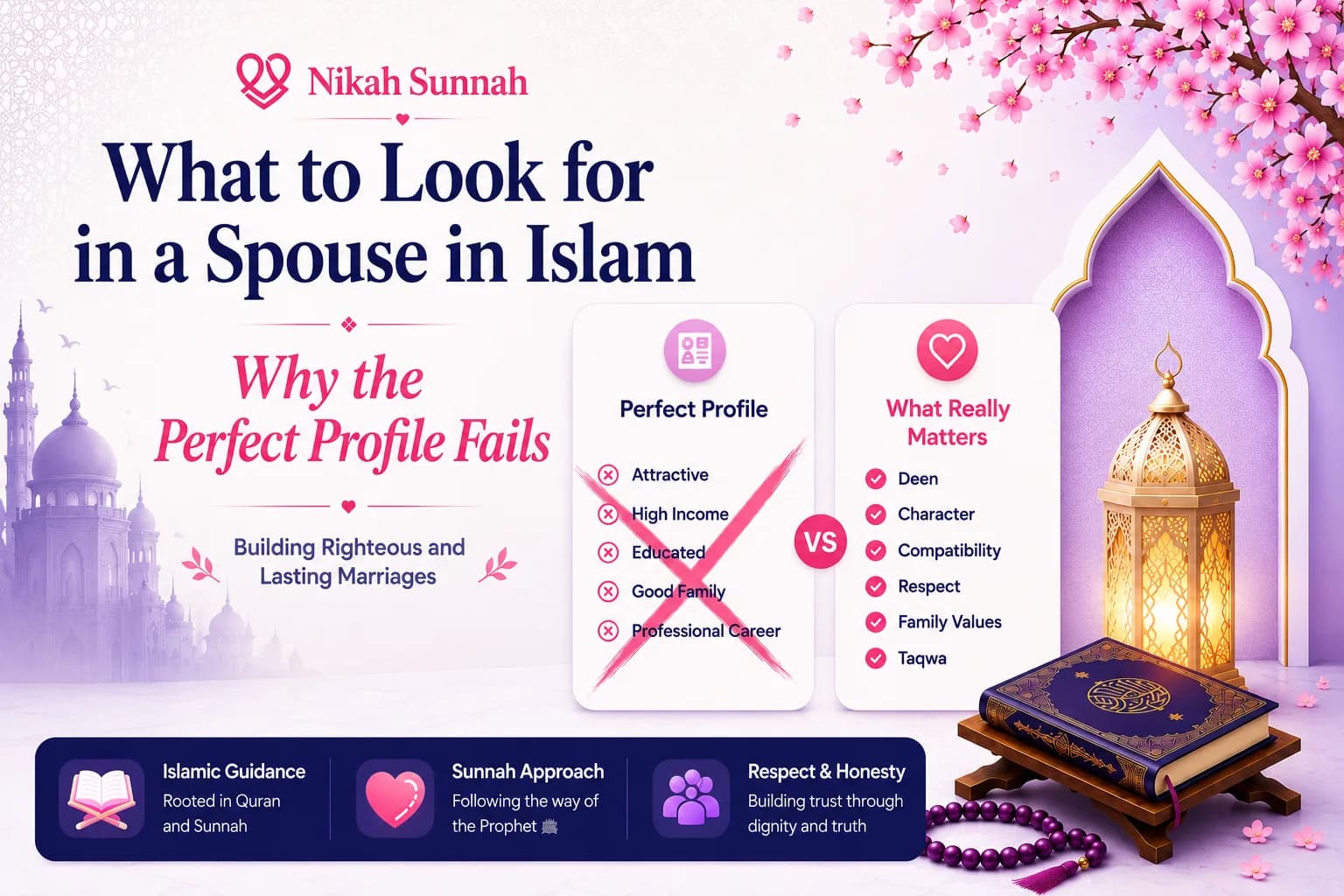
What to Look for in a Spouse in Islam: Why the Perfect Profile Fails
I've heard this story more times than I can count now. The profile comes through he's abroad, well-settled, the right degree, the right height, good family background. Or her profile comes through she's beautiful, writes about her qualifications, the family is well-respected. Calls are exchanged. Guardians are involved. Somewhere in the background you can hear families calculating whether this is finally the one.